

What Happens When You Get a DUI In Florida?
Driving under the influence of alcohol or drugs puts you in danger. As well as everyone else on the road. If you aren’t sober, it’s always better to get a ride with someone who is. According to the CDC, Florida’s number of intoxicated drivers is higher than the national average. If you’re a Florida driver, you may want to brush up on Florida DUI laws. So, you know what to expect after getting a DUI in Florida.
DUI laws can be complicated, and there are a lot of factors for the court to take into consideration when deciding on a suitable punishment for the crime. It goes without saying that if you’ve gotten a DUI, your first step should be to hire a DUI attorney.
What are some of the possible outcomes of a DUI in Florida? What should you expect in the days and months after getting arrested for driving under the influence? Read on to find out everything you need to know.
What Counts as a DUI In Florida?
Florida DUI laws can get a little bit confusing, so let’s start with what officially counts as a DUI in Florida. The basic concept is that if you’re over the legal limit of intoxication while driving, you’ve broken the law. The question is, how do you know when you’ve crossed the legal limit?
Like other states, Florida considers a BAC level of 0.8% or higher over the legal limit. If you are asked to take a breathalyzer test and blow a BAC of 0.8% or higher, you will receive a DUI.
That being said, this isn’t the only way to land a DUI. Police officers are also allowed to make a judgment about whether your normal faculties (ie seeing, walking, and driving) are impaired by the use of a substance. As such, a DUI can also apply to instances when a driver was on a drug (including some prescriptions) that impaired their ability to drive safely.
What Happens Next?
So you’re pulled over and arrested for driving under the influence. After the initial arrest, you can expect at least one. If not several–dates in court, when a judge will determine what punishments you should face for your crime. Most of the time, DUIs are considered misdemeanors, but the consequences can still be harsh.
Fines
DUIs result in fines that can add up quickly. Even after your first DUI in Florida, you can expect a fine of no less than $500. If you blew a BAC of 0.15% or higher, that fee will be at least $1,000 and could be as high as $2,000.
But, if it’s your second DUI, your fine will be no less than $1,000. And, if it’s your third, it will be no less than $2,000. As you can see, getting a DUI is an expensive matter.
Community Service
Community service is often one of the requirements you will need to fulfill after getting a DUI. How much community service you have to do (and what options are available to you) will vary from case to case. A first offense DUI tends to come with a mandatory 50 hours of community service, which you can skip in exchange for another $10 fee per hour of community service you don’t serve.
Probation
Most first-time offenders who are in court for a DUI receive a minimum of six months of probation. During this time, you may be required to periodically check in with a probation officer. There may be limitations on your ability to travel, and this could last anywhere from six months to one year depending on the conditions of your DUI.
Jail Time
Not everyone who gets a DUI will walk away with jail time, but it is a possible consequence whether it’s your first DUI or your third.
For your first offense, you may face up to six months of jail time. If your BAC level was 0.15% or higher, that maximum sentence goes up to nine months.
For your second offense, you may face up to nine months of imprisonment. If your third offense is within ten years of your second offense, you will face a mandatory sentence of at least 30 days. Depending on the circumstances of your DUI, that could last up to twelve months.
License Suspension
After getting a DUI, you will definitely face license suspension. The minimum length of time for a first offense is 180 days, which is a long time to go without a license. You may be able to apply for a hardship license that first time, but after a second offense, you will not be granted one.
When Is a DUI In Florida a Felony?
As we mentioned earlier, most DUIs are misdemeanors–but not all. At what point does a DUI become a felony?
There are three circumstances under which a DUI can become a felony:
- DUI Manslaughter: another person was killed by the intoxicated driver
- DUI with serious bodily injury: another person was seriously injured or harmed by the intoxicated driver
- Third offense DUI
Once a DUI is considered a felony, it is possible to face a prison sentence of one year or longer. In turn, many of the other punishments are harsher, as well.
Don’t Fight DUI In Florida Alone-Hire RHINO Lawyers
Florida DUI laws tend to get complicated. If you received a DUI in Florida, don’t try to fight it alone. With the help of RHINO Lawyers, you may be able to avoid a suspended license, receive lighter fines, lower your jail time, and more.
To get started, contact us for a free case review. You tell us the facts of your case and we’ll let you know what kind of sentence you may be looking at, how we can help you, and more.
CONTACT TAMPA TRAFFIC TICKET ATTORNEY
RHINO Lawyers can help and guide you through a system molded by law enforcement, judges, and lawyers for decades. Having won cases for our clients in similar circumstances, our criminal defense team knows what it takes to fight on your behalf.
Let RHINO Lawyers answer your questions and review the facts of your case with a Free Consultation. So, get started by completing the “Free Instant Case Evaluation” or by calling us any time, day or night, at 844.329.3491.
Read More
What Is Considered Careless Driving?
Every year in Florida there are more than 400,000 car accidents. Many of these are careless driving antics.
As a driver, you must drive responsibly and courteously. When you’re behind the wheel of a car, you could cause an accident simply through carelessness. If you’re caught out driving in this fashion, you could receive a careless driving ticket.
If you have received a careless driving ticket, you may be wondering what the next step should be.
In this article, we’ll talk about careless driving in Florida and what you can do to defend yourself if you have a ticket.
What Is Careless Driving?
In Florida law, careless driving is defined as anyone not operating a vehicle on the roads in a careful and prudent manner.
The law states that you need to pay attention to the width, grade, curve, corners, and other traffic on the road. You must not endanger anyone else’s life, nor cause injury or damage to any person’s property.
To be clear though, no injury or harm needs to come to anyone and no damage needs to have occurred for the charge to be given.
How Much Is a Careless Driving Ticket?
Careless driving is a moving violation.
If you get caught and charged with it you can expect to receive a fine of up to $500 as well as any court costs if you are adjudicated guilty. Adjudication is a term that is used in place of ‘convicted’ on a non-criminal case.
The minimum fine that you can expect to receive for careless driving is $160.
How Many Points Is Careless Driving?
In addition to having a fine, you will also get points on your license.
You can expect to receive four points on your driver’s license if you are adjudicated guilty. In some cases, you can have the number of points you receive reduced if you are willing to take a driver education course.
Drivers who have had points applied to their license can expect to see an increase in the cost of their automobile insurance.
Careless Driving vs Reckless Driving
So what is the difference between careless driving and reckless driving?
Careless driving is not a criminal offense, whereas reckless driving is. Reckless driving is defined as driving a vehicle with a disregard for other people’s safety.
Some examples of reckless driving include:
- Drag racing on a public road
- Distracted driving
- Driving under the influence of drink or drugs
- Failure to yield to pedestrians or anyone that has the right of way
- Swerving through traffic in a dangerous way
- Running red lights and stop signs without any regard for the safety of others
The penalties for reckless driving could be up to 90 days in jail, and a fine of up to $500. If a person is convicted more than once, the penalties become steeper.
The fines could be up to $1,000 and a person may go to jail for up to six months.
In the event that a person’s reckless driving causes serious injury or death, they will face a fine of $5,000 and up to five years in prison.
Defending a Careless Driving Ticket
A careless driving charge is reliant on the opinion of the officer making the accusation. A person may face these charges when their driving was not actually a danger to other people.
Another reason that someone may face a careless driving ticket is if they were swerving to avoid a dangerous situation.
There may be times when a driver needs to make a decision that makes it look as though they were not driving with due care and attention when in reality they were trying to stop something bad from occurring.
Other defenses for careless driving tickets include:
- If you were wrongly accused as you were not the person who was driving
- You hit another vehicle, however, you were driving in a way that was careful and prudent
- If you hit another vehicle because of bad weather
- You hit another vehicle because another vehicle crashed into the back of yours
- There was a defect in your vehicle which caused you to drive in a way that looked like you were being careless
- Your mechanic failed to maintain your vehicle which caused an operating error that made it look as though you were driving carelessly
Regardless of the reason for the careless driving, a person being charged will be based on the opinion of the officer. This means that the case can be challenged and won with the right defense.
Challenging Your Careless Driving Ticket
If you get a careless driving ticket, you should challenge it. The first thing that you will need to do is to hire an experienced traffic defense lawyer.
Having a lawyer on your side that understands the specifics of the traffic laws and who has represented numerous clients in similar situations to yourself will put you in good stead for winning your case.
Hire an Experienced Lawyer
Careless driving is when you are driving without due care and attention.
Getting a careless driving ticket doesn’t necessarily mean that you’ll end up with a $500 fine and four points on your driver’s license. It is possible that with the right defense you can have your ticket overturned.
Have you had a careless driving ticket? Rhino Lawyers are here to help you. Get in touch today to find out how we can help you.
CONTACT TAMPA TRAFFIC TICKET ATTORNEY
RHINO Lawyers can help and guide you through a system molded by law enforcement, judges, and lawyers for decades. Having won cases for our clients in similar circumstances, our criminal defense team knows what it takes to fight on your behalf.
Let RHINO Lawyers answer your questions and review the facts of your case with a Free Consultation. So, get started by completing the “Free Instant Case Evaluation” or by calling us any time, day or night, at 844.329.3491.
Read More
7 THINGS TO DO AFTER GETTING A RECKLESS DRIVING CHARGE
Surprisingly, it doesn’t take a lot to be charged with reckless driving. You may not even realize how far over the speed limit you are until you’re pulled over.
But then, bam. Here’s the ticket. And that little piece of paper that signifies you received a reckless driving charge can impact your life for years to come.
If you are charged with reckless driving and aren’t sure what to do next, keep reading. Here are the 7 things you must do after getting a reckless driving charge.
1. Stay Calm
We get it – no one wants a ticket, especially one that has the ability to escalate into more serious charges. You might feel like giving the police officer a piece of your mind, and who could blame you?
However, if you want to avoid further trouble, you must remain calm. The police officer may have to show up in court to testify against you. Wouldn’t you rather leave him with the impression that you are respectful and polite?
Not to mention, there are different degrees of reckless driving charges in Florida, with some being more serious and carrying harsher penalties. Don’t give the officer an excuse to increase your charge.
2. Slow Down
Sounds obvious, right? But you should drive more carefully, not just to avoid getting a second charge, but also to avoid making your first charge even worse.
Reckless driving charges in Florida can escalate all the way into a felony. If you catch a second ticket while still awaiting your court appearance for the first, it could stay on your record permanently.
Felonies can prevent you from getting a job or an apartment and can significantly impact your life. It’s not worth the risk for a few extra miles per hour.
3. Educate Yourself
Take time to read up on Florida’s reckless driving laws. It’s never a bad idea to learn more about the situation you’re in. You’ll also be aware of where to draw the line the next time you feel like speeding up.
If you know anyone who has also received the same charge, call them up. Ask them about their experience and what they would do differently if they could go back. You may learn something that could improve your situation.
4. Research and Hire a Lawyer
Because this charge can escalate, you can’t afford not to have a lawyer. But you should always do your research first.
There are lawyers, such as our team at RHINO Lawyers, who focus on traffic law and reckless driving charges. Our lawyers have years of experience working with this type of charge, so we’ve seen it all. We can handle your case with skill.
Any reputable firm (including RHINO Lawyers) will offer a free consultation to determine whether your case is a good fit. You want an attorney who is a hundred percent sure they want to take your case before an engagement letter is signed.
5. Listen To Your Lawyer
If you’ve done your research and hired a good attorney, you should remember you are paying them to tell you what to do to get the best outcome. They’ve done this before, and they know how you should act.
Even if you don’t want to do something, listen to your lawyer. Get a new suit, take driving classes, volunteer – whatever it is, they are telling you to do it for a reason, even if it isn’t immediately clear to you.
The legal system is a confusing, tangled web. You’ll have an easier time if you listen to the professional at your side.
6. The Hearing: Be Serious, Have Evidence
Your lawyer will prep you for the finer points of the hearing, but it’s important to remember to take it seriously. They should communicate what you do with your appearance, expressions, and body language.
Getting charged with something where someone could have ended up injured or dead, and acting nonchalant about it, is an easy way to annoy the judge. The judge has the power to sanction you or increase your punishment, so it’s better to try to stay on their good side.
At the hearing, both sides can present evidence. The officer who gave you the ticket may testify. There may be other witnesses if other people were involved, such as in an accident.
If you had anyone else in the car with you, you may want to call them to testify as well. If you have a dashcam or are able to ask a nearby home or business for their security camera footage, that’s even better.
Because you’ve educated yourself about your charges, you may even be able to dispute parts of the officer’s testimony or parts of the charge itself. It will ultimately be up to your lawyer to pursue that, but make sure to pay attention. See if you notice any discrepancies in how the prosecution portrays what happened.
7. Learn From This Experience
Your punishment can range from a fine to a short time in jail, to a full felony charge with significant prison time. But whatever happens, you should accept your penalty with grace and carry it out with your head held high.
Afterward, think about what you can take from this experience. It’s unrealistic to think that you will never speed again while driving, but maybe you’ll be more careful in the future.
If You Have a Reckless Driving Charge in Florida
If you’ve received a reckless driving ticket recently, don’t delay in reaching out for help. The longer you wait, the less time you have to prepare for your court appearance.
Our team at RHINO Lawyers works collaboratively on each case. We’re always learning from each other so that we can provide the best possible outcome for each and every client.
Reach out to us today to schedule a free consultation about your reckless driving charge. You’ll be glad you did.
CONTACT TAMPA TRAFFIC TICKET ATTORNEY
RHINO Lawyers can help and guide you through a system molded by law enforcement, judges, and lawyers for decades. Having won cases for our clients in similar circumstances, our criminal defense team knows what it takes to fight on your behalf.
Let RHINO Lawyers answer your questions and review the facts of your case with a Free Consultation. So, get started by completing the “Free Instant Case Evaluation” or by calling us any time, day or night, at 844.329.3491.
Read More
TIPS AND TRICKS ON HOW TO FIGHT A TICKET
There are upwards of 50 million traffic tickets given out each year. Making the business a multi-billion dollar business that’s not going anywhere anytime soon. If you’re one of the unlucky people who has received a traffic ticket, you may be wondering how to fight a ticket.
We’re here to give you some tips to help you know how to fight a traffic ticket. While it may work in some scenarios. It’s not always going to get you out of having to pay that fine.
Continue reading now for everything you need to know when it comes to disputing an unjust traffic ticket.
Get Ready for Court
If you’re not willing to pay a traffic ticket that you feel you’ve been given wrongly, one of the best things you can do is go to court. But, there are some things that you need to do before getting to court.
One of the first things you need to do is find a lawyer and a good one at that. Your lawyer will have a working knowledge of the law. And, be able to find ones that pertain to your case.
These laws may prove that you were not in the wrong and can get the ticket thrown out. Meaning that you don’t have to pay the fine. Ensure that you show up early on the day of court and are ready when they call your name.
The worst thing you can do when fighting a ticket in court is showing up late and unprepared.
Talk the Ticket Away
If you get pulled over and absolutely don’t want to get a ticket, you can always try talking your way out of it. We know you’ve seen it done time and time again on television. But in real life, it may not be that easy to do.
When you’re looking to talk your way out of a ticket, you must remember to remain as calm as possible during the entire time you’re interacting with the ticketing officer. You don’t want to create any situation that would cause the officer to suspect that you’re trying to do something that would warrant further actions, such as an arrest.
You’ll find that when you’re looking to talk your way out of a ticket, being as polite as possible will go a long way. When the officer sees that you’re complying with everything they’re saying and have things like your driver’s license and registration ready to go, it may lead them to let you go without a ticket.
Traffic School
There are going to be times when even if you’ve hired a lawyer and argued your case or attempted to talk your way out of a traffic ticket, it simply won’t be enough. In the end, you’ll have to pay the ticket. And, depending on the severity of the speeding ticket, you may face having points on your license.
This is when you should take the initiative and enter traffic school. By taking a traffic school course, you can avoid having those points placed on your license, which means that you don’t have to worry about your insurance going up as a result.
Prove There Was a Mistake
Take the time to look the ticket over carefully once it’s been received. As well as take note of what you received the ticket for. There will be times when you’ve received a ticket, and it was a mistake on the officer’s part.
It’s your job to identify this mistake and point it out in court. For example, if there was a tree that was blocking a stop sign, and you received a ticket for not stopping. Because a judge may consider this when it comes to dismissing the ticket.
More Significant Harm Could’ve Happened
If you got the ticket for avoiding causing an accident or some other harm to yourself and other drivers on the road. This could be a reason to throw the ticket out. But, you would have to relay this information to your lawyer and let them argue it in court.
They will need to prove that had you not made the violation that you made, something worse could’ve happened to you and others around you. The judge will consider this, and as long as the argument was made effectively, you could be looking at a ticket dismissal.
Of course, for all these things to take place, it’s essential that you have a lawyer who knows what they’re doing. The lawyer should have represented cases like yours in the past.
It will help provide you with the confidence you need to trust them and increase the odds of getting the results you’ve been looking for. A good lawyer will make all the difference when you get to court.
Traffic Ticket: Coming to a Full Stop
When it comes to getting out of a traffic ticket, there are various things that you could try to increase your chances of getting out of a ticket or not getting a ticket in the first place. You could try to talk your way out of a ticket. Or, you could hire a lawyer and have them argue your case in court.
Speaking of lawyers for all your auto court case needs, contact RHINO Lawyers. We’ve got the knowledge and experience to help you achieve the results that you’re looking for.
All you’ve got to do is reach out to our team of legal professionals.
CONTACT TAMPA TRAFFIC TICKET ATTORNEY
RHINO Lawyers can help and guide you through a system molded by law enforcement, judges, and lawyers for decades. Having won cases for our clients in similar circumstances, our criminal defense team knows what it takes to fight on your behalf.
Let RHINO Lawyers answer your questions and review the facts of your case with a Free Consultation. So, get started by completing the “Free Instant Case Evaluation” or by calling us any time, day or night, at 844.329.3491.
Read More
IS A TRAFFIC VIOLATION A CRIMINAL OFFENSE?
One in every 5 American adults has received traffic tickets as a result of a moving violation in the last 5 years.
Whether you get pulled over for speeding, running a stop sign, or for something more serious. Like a DUI, getting a ticket can be scary, confusing, and very expensive. Depending on the severity of your violation, it could also have severe consequences, like jail time and hefty fines. Or even cause you to lose your job.
But before you ever find out what consequences you’re going to face, you’ll likely have some questions about the ticket itself. One big one many drivers have is whether you’ll be facing criminal charges.
Is a traffic violation a crime? Keep reading to find out.
Is a Traffic Violation a Crime?
Unfortunately, the answer to this question isn’t straightforward. That’s because there are many different types of traffic violations. Some are more serious than others.
Instead, the answer is that some traffic violations are considered crimes, while others are not.
Types of Traffic Violations that are Not Considered Crimes
Many of the most common traffic violations are not considered crimes. This means that if you are pulled over and ticketed by a police officer for one of these violations, you’ll go to traffic court.
Some examples of minor, non-criminal traffic violations include:
- Speeding
- Running a red light
- Texting and driving
- Changing lanes in a way that is not safe
- Running a stop sign
If you receive a ticket for one of the above violations, you’ll go to traffic court. There, your violation will be classified as either an infraction or a civil offense.
In most cases, you’ll face a fine. You’ll pay your fine and receive points on your license.
However, in some states, including Florida, you also have the option of attending traffic school after receiving a ticket for a minor traffic violation. By agreeing to and then attending traffic school, you may be able to lower your fine. Or even avoid getting points on your license. Some traffic school courses can even be attended online, so you won’t need to miss work or school in order to attend.
If you feel that you received a ticket for something you were not guilty of, you also have the option of fighting back. With the help of an attorney, you can fight the ticket and prove your innocence. This means no paying fees or receiving points on your license, without having to attend traffic school.
Types of Traffic Violations That are Considered Crimes
While minor traffic violations are typically classified as civil offenses or infractions, more serious violations can be considered crimes. This means that they’ll carry criminal charges as well.
Some examples of serious traffic violations that are considered crimes include:
- Driving under the influence of drugs or alcohol, also known as DUI
- Reckless driving that endangers other drivers or your passengers
- Leaving the scene of an accident, also known as a hit and run
- Vehicular homicide
- Driving while your license is suspended or after it has been revoked
- Attempting to run from law enforcement following a traffic violation
- Driving without a license
- Racing on a highway
- Driving with an expired vehicle registration
- Using a tag that is not assigned to that vehicle
When a traffic violation is considered a crime, it will often be categorized as a misdemeanor. However, depending on the circumstances, it could also be classified as a felony.
In most cases, the violation will be elevated to a felony if the person responsible is a repeat offender or if the crime led to serious property damage, injuries, or death. You could also receive a felony charge if you are pulled over and found in possession of or attempting to sell or distribute drugs.
Many criminal traffic violations will result in immediate arrest. You may need to post bail in order to get released and then appear in court to learn what charges you face.
Depending on the severity of the crime, you may face fines or jail time, lose your license, and more.
What Should You Do After Receiving a Traffic Ticket?
Whether you’re caught speeding or arrested for a DUI, facing the consequences can be stressful. You might find yourself wondering what your options are. Or if you feel that you were unfairly accused, you may wonder what your options are.
That’s where an attorney can help.
No matter the severity of your traffic violation, a lawyer who focuses on traffic law can help you navigate your options and guide you through the legal process. He or she will not only help you understand the charges that you could face but will also represent you in court so that you won’t have to appear.
If you decide to dispute your ticket, whether you actually think that you’re guilty or not, they’ll help you do just that. In fact, your attorney may advise attempting to dispute your ticket, as this is your only chance of getting it dismissed.
Finding a Traffic Law Attorney
Now that you know the answer to the question, “Is a traffic violation a crime,” as well as a little about the difference between different traffic violations, it’s time to take care of your own ticket.
Whether you were arrested for a serious offense like a DUI or received a ticket for speeding or running a stop sign, having an attorney on your side can make all the difference. Besides fighting for you in court, your attorney can also ensure that you understand all of your options when it comes to fighting charges, lowering fines, or avoiding accumulating points on your license.
If you’ve received a ticket or been arrested for a traffic violation, we can help. Contact us today for a free case review or video consultation.
CONTACT TAMPA TRAFFIC TICKET ATTORNEY
RHINO Lawyers can help and guide you through a system molded by law enforcement, judges, and lawyers for decades. Having won cases for our clients in similar circumstances, our criminal defense team knows what it takes to fight on your behalf.
Let RHINO Lawyers answer your questions and review the facts of your case with a Free Consultation. So, get started by completing the “Free Instant Case Evaluation” or by calling us any time, day or night, at 844.329.3491.
Read More
CRIMINAL TRAFFIC OFFENSES IN FLORIDA
First, criminal traffic offenses occur when individuals commit criminal offenses while driving. In Florida, a person can receive a criminal traffic offense for several reasons. Like, accruing too many points on their license and driving under the influence. Or, harming another person with a vehicle. So, some of the most common criminal traffic offenses include:
- Fleeing to Elude Law Enforcement
- Driving While License Suspended (DWLS)
- No Valid Driver’s License (NVDL)
- Leaving the Scene of an Accident
- Habitual Traffic Offender (HTO)
- Driving Under Influence (DUI)
- Reckless Driving
- Failing to Register a Vehicle Ticket
- License Reinstatement
- Unlawful Tag Ticket
- Drag Racing Ticket
- Vehicular Homicide
- Vehicular Manslaughter
Moving Violations and Criminal Traffic Violations Differences
Thus, drivers who break the law will receive a traffic violation. Either a moving violation or a criminal traffic violation. And, drivers caught committing a moving violation to get a ticket and points on their license. Although moving violations have less severe punishments. Many moving violations will result in serious penalties. Like, getting labeled a Habitual Traffic Offender.
But, criminal traffic violations have serious penalties. And, drivers caught could receive a misdemeanor charge. Or, a felony charge on their criminal record. As well as, larger fines or jail sentences. Also, these offenses could prevent employment or obtaining housing. Also, it could even restrict the person’s rights to own a firearm.
Habitual Traffic Offender Revocations
With regard to, habitual traffic offender charges carry severe penalties. As a matter of fact, as an HTO could lose your right to drive for five years or have your license revoked forever. Thus, wreaking havoc on your life.
Now, under Florida Statutes 322.264, HTO’s commit and get convicted of three or more criminal traffic offenses. Furthermore, these convictions are within a 5-year timeframe. For example, here are some criminal traffic offenses:
- DUI (Driving under the influence)
- Voluntary or involuntary manslaughter
- Any felony resulting from the use of a motor vehicle
- Driving while a license suspended or revoked
- Failing to stop and render aid in the event of a motor vehicle crash
- Driving a commercial motor vehicle with a suspended license
FACTS TO KNOW ABOUT TRAFFIC OFFENSES
Next, law enforcement officers issue many traffic citations daily. And, these citations range from speeding to violation of a traffic control device. With so many citations issued, here are some important facts everyone should know.
- Most citations add points to your license.
- 12 points in 12 months equal a suspended license.
- Toll violations carry fines of $100 or more and could lead to a suspended license.
- You can dispute red light camera tickets.
- Many traffic citations are criminal acts.
- It is worth getting help from a criminal defense attorney, like RHINO Lawyers.
CONTACT TAMPA TRAFFIC TICKET ATTORNEY
RHINO Lawyers can help and guide you through a system molded by law enforcement, judges, and lawyers for decades. Having won cases for our clients in similar circumstances, our criminal defense team knows what it takes to fight on your behalf.
Let RHINO Lawyers answer your questions and review the facts of your case with a Free Consultation. So, get started by completing the “Free Instant Case Evaluation” or by calling us any time, day or night, at 844.329.3491.
Read More
5 DRIVING TIPS FOR FLORIDA VISITORS
So, you want to visit the Sunshine State. Whether you’re coming to see family, friends, or vacationing on the beach. If you intend on driving there are things you need to know before getting behind the wheel. Because no one wants to have their trip ruined by a traffic citation. While Florida has similar laws as the rest of the country here are 5 driving tips to help anyone visiting the state.
Click-it Or Ticket
First, driving tip while visiting Florida, buckle-up it’s the law. Besides, wearing a seatbelt saves lives. So, when you get into a vehicle put your seatbelt on and make sure passengers do the same. If you have a child or children in the car they will need an applicable child restraint to help keep them safe. With this in mind, if you don’t buckle up and you get pulled over you will receive a non-moving traffic violation.
Driving And Using A Cell Phone
Second, driving tip using a cell phone to make a call while driving is not illegal. Even though talking on the phone while driving is common it does make driving more dangerous. Yet, texting and driving are illegal in Florida. And, if you get pulled over for texting you will receive a noncriminal traffic violation for the first offense. But, a second offense will get you a moving violation. So, to be safe put your phone away when driving.
Florida’s Move Over Law
Third, driving tip while visiting Florida, most out of state visitors don’t know this but Florida has a “move over” law. And, this law requires drivers to safely move over a lane for stopped law enforcement and, emergency vehicles. As well as, for stopped sanitation trucks, utility service vehicles, and tow trucks. Now, the law has an exception. When you cannot change lanes you need to slow to a speed that is 20 mph less than the posted speed limit. But, if the posted speed limit is 20 mph or less you need to slow to 5 mph. Because violating this law puts lives at risk penalties are more serious adding fines, fees, and points to your license.
Right On Red
Fourth, driving tip Florida does allow drivers to turn right on red. But, per Florida law, the driver must come to a complete stop at the stop line before turning. As well as, they should not proceed until the crosswalk or intersection is clear. Granted, this does not apply at intersections that have a “no turn on red” sign.
Motorist and Cyclist Share Public Roads
Fifth, the Sunshine State generally has great weather for cycling year-round. Due to this, motorists and cyclists share most public roads. Even though, not every road has a designated bike lane. So, cyclists have to ride alongside the motorists driving. Also, cyclists share the same rights and responsibilities as motorists on the road. In other words, cyclists follow the same rules as a motorist. But, motorists get an extra rule, they must allow three feet when passing a cyclist.
CONTACT TAMPA TRAFFIC TICKET ATTORNEY
RHINO Lawyers can help and guide you through a system molded by law enforcement, judges, and lawyers for decades. Having won cases for our clients in similar circumstances, our criminal defense team knows what it takes to fight on your behalf.
Let RHINO Lawyers answer your questions and review the facts of your case with a Free Consultation. Get started by completing the “Free Instant Case Evaluation” or by calling us any time, day or night, at 844.329.3491.
Read More
NEW DRIVER ADVICE AND GENERAL RULES
First of all, diving is a privilege for anyone, but especially for those new drivers. And, with it comes to a sense of freedom for them. But, you can quickly lose that freedom by not driving safely or following the rules of the road. So, you don’t lose that new driver’s license we put together some new driver advice and general rules to help keep you on the road.
Advice for new drivers
If you are a new driver or learning to drive we don’t want you to lose this privilege. So, here is some advice to help you stay safe and keep your driver’s license.
New Drivers should Practice, Practice, Practice
Before you can get your driver’s license, you must prove you have completed the required hours of practice driving. Now, if you take a driving course like Drivers Ed your instructor will document these hours. But, if you don’t take the course you can practice with a parent and keep a log of your hours. Like, anything the more you practice the better you will get, so practice as much as possible.
Keep your hands on the wheel
Given that, to drive safely you must have control over your car. When you drive with lazy hands or both hands not on the steering wheel you diminish that control. So, it is important to keep both hands on the steering wheel. In fact, the proper positions to place your hands are either ten and two or nine and three.
All Drivers put your cell phone away
For one thing, texting and driving are illegal. Even though, using a cell phone to make a call while driving is common to see, it’s makes driving more dangerous. Because when you use your phone you do not give 100% of your attention to the road. And, the fewer distractions while driving the safer you and the people around you are.
Use your headlights
Next, use your headlights or the automatic headlight setting if your car has that feature. Besides, it makes you visible to other cars and pedestrians it’s the law to use your headlights from dusk to dawn. Also, you should always use your headlights when your windshield wipers are on.
Whether a new driver or experienced don’t drive aggressively
Consequently, aggressive driving can land you with a ticket, or worse an accident. So, don’t tailgate, speed, or zip in and out of lanes. And, if someone is tailgating you, let them pass. Do not block them from passing or slam on your brakes. As this behavior will only make your drive more dangerous. Not to mention, if you have an accident because of these actions you could share in the fault of the accident.
General rules for driving
Whether you are a new driver or experienced driver here are some basic rules of the road to keep you safe.
- Buckle-up it’s the law.
- Use the appropriate child safety seat for your young passengers.
- Pullover to the right side of the road for emergency vehicles and wait for them to pass.
- Don’t drink and drive. And, if you do drink, use a rideshare program or sober friend to get home.
- Typically, roundabouts allow for continuous moving at a slow speed. Although, as you approach a roundabout you should yield to the circulating traffic.
- You should pass on the left and drive in the right lane.
- When stopped at a stop sign always yield the right-of-way to pedestrians and other traffic.
New Drivers and Speeding
Lastly, next to distracted driving, speeding is one of the leading causes of accidents with new drivers. Additionally, more drivers receive speeding tickets than any other traffic ticket. So, pay attention to the posted speed limit when you are driving.
And, driving the speed limit will help you avoid getting a speeding ticket. As well as, the increased insurance rates that follow. Alternatively, driving too slow and blocking traffic will also land you a ticket. Thus, to be safe drive within the speed limit and with the flow of traffic.
CONTACT TAMPA TRAFFIC TICKET ATTORNEY
RHINO Lawyers can help and guide you through a system molded by law enforcement, judges, and lawyers for decades. Having won cases for our clients in similar circumstances, our criminal defense team knows what it takes to fight on your behalf.
Let RHINO Lawyers answer your questions and review the facts of your case with a Free Consultation. Get started by completing the “Free Instant Case Evaluation” or by calling us any time, day or night, at 844.329.3491.
Read More
TOP SPEEDING TICKET MYTHS DEBUNKED
First of all, speeding tickets are the most common traffic tickets in the US. And, that remains true for tickets issued in and around Tampa and Hillsborough County. So, if you get a speeding ticket you have options. But, due to rumors, urban myths, and misinformation online many people make the wrong choices when handling their ticket. For this reason, here are the top speeding ticket myths debunked.
If the office doesn’t show up in court your ticket is dismissed.
Well, this myth is half true. But, it depends on the state and their rules around officers appearing in court. Actually, some states do not need officers to appear. While other states do require the ticketing officer to appear or the judge will throw out the case. Either way, if you fight your ticket don’t do it alone, make sure you have a traffic ticket attorney by your side.
Errors on your speeding ticket will get your case dropped.
So, the officer made a mistake on your speeding ticket. Does this mean your ticket is not valid? If they made a typo like spelling, wrong number, or another minor error – your ticket is valid. But, if they make a major error like they did not sign the ticket. Or, cited the wrong law could benefit your case if you contest the speeding ticket.
Speeding Tickets don’t follow you from state to state.
Considering, this myth was once true. It is understandable that it still exists among the rumors. But, this stopped when states started participating in the Interstate Driver’s License Compact. The DLC is an agreement between states to share traffic violation information. In other words, they let your home state know about your speeding ticket. So, you can’t escape paying the speeding ticket.
Matching the speed of traffic or passing slower traffic are grounds for dismissal.
To tell the truth, no this is not true. As a matter of fact, once to go over the speed limit you have broken the law. So, it does not matter if the person in front of you is driving slower or you are matching the speed of traffic. When you are behind the wheel you need to follow the posted speed limit.
Officers Have End of the month quotas.
As for quotas, this is a myth I have heard since I was a kid. And, of course, it is not correct. Like, all jobs police officers have performance expectations. Now, their supervisor may use the number of tickets written to gage productivity. But, they do not have a quota to meet each month.
CONTACT TAMPA TRAFFIC TICKET ATTORNEY
RHINO Lawyers can help and guide you through a system molded by law enforcement, judges, and lawyers for decades. Having won cases for our clients in similar circumstances, our criminal defense team knows what it takes to fight on your behalf.
Let RHINO Lawyers answer your questions and review the facts of your case with a Free Consultation. Get started by completing the “Free Instant Case Evaluation” or by calling us any time, day or night, at 844.329.3491.
Read More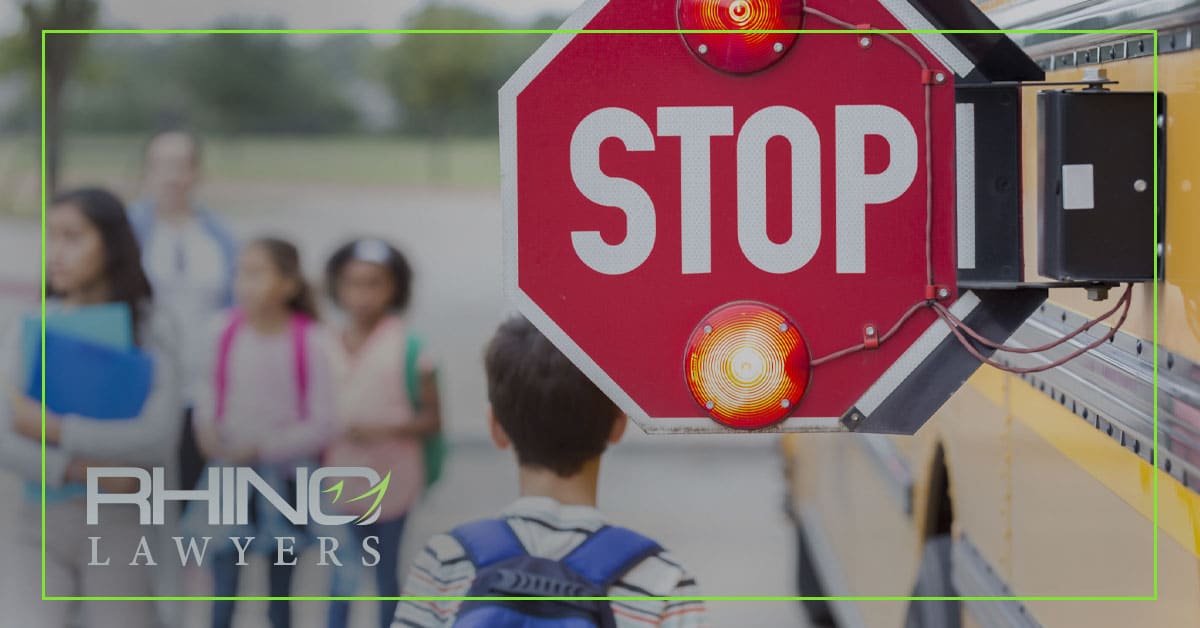
PENALTIES FOR PASSING A STOPPED SCHOOL BUS
To start with, a new school year brings the addition of school buses to the roads. Thus, buses will start taking students to and from school. And, drivers will need to remember there are penalties for passing a stopped school bus.
But, some drivers forget or get distracted ignoring the safety features. Like, the flashing yellow and red lights and the stop sign on the side of the bus. Additionally, they made the rules around stopping for a school bus simple.
- Two-lane roads – all vehicles traveling either direction have to stop.
- Multi-lane roads with a paved center – again all vehicles have to stop.
- Divided roads or highways with a 5ft unpaved median, raised median, or barrier – Any vehicle traveling behind the bus must stop. And, vehicles traveling in the opposite direction do not need to stop but should drive with caution.
Florida Penalties for Passing A Stopped School Bus
Next, like most states, Florida takes this traffic offense seriously. Because when you don’t stop for a school bus loading or unloading kids, you endanger their lives. Thus, Florida Statute 318.18 states the following:
Failure to Stop for School Bus
- 4 points on your license
- Up to a $165 fine
- Mandatory hearing
- A second offense within 5 years adds a suspended license up to 6 months.
Failure to Stop Passing the Side Kids Enter and Exit
- 4 points on your license
- Up to $265 fine
- Mandatory hearing
- A second offense within 5 years adds a suspended license up to 1 year.
A Violation Causing Serious Injury
- 6 points on your license
- Up to $1500 fine
- Mandatory hearing
- A suspended license not less than 1 year.
Additionally, these penalties will increase as of January 1, 2021. Because the Florida Senate and Gov. Ron DeSantis recently approved and passed House Bill 37 doubling the penalties.
SCHOOL BUS RIDER SAFETY TIPS
Even though, riding the bus to school is one of the safest alternatives to parents dropping kids off at school. Unfortunately, drivers fail to follow the rules. Which can result in a citation or worse an accident. So, here are some safety tips to help keep your child safe as they prepare to ride the bus.
- Make sure they give themselves enough time to get to the bus stop.
- Stay alert. So, they can see and hear cars on the road.
- Don’t stand on the edge of the road. Try to stay at least 5 steps from the edge or curb.
- If they need to cross the road always wait for the bus driver to signify it is safe to cross. Even if the bus driver says it is safe, look both ways before crossing.
- Never try to board the bus while it is moving. Always wait for the bus to stop and open the doors indicating it is safe to board.
- The same goes for exiting the bus. They should not get out of their seat to exit until the has stopped.
- While on the bus sit facing forward and don’t hang anything out the window.
CONTACT TAMPA TRAFFIC TICKET ATTORNEY
RHINO Lawyers can help and guide you through a system molded by law enforcement, judges, and lawyers for decades. Having won cases for our clients in similar circumstances, our criminal defense team knows what it takes to fight on your behalf.
Let RHINO Lawyers answer your questions and review the facts of your case with a Free Consultation. Get started by completing the “Free Instant Case Evaluation” or by calling us any time, day or night, at 844.329.3491.
Read More